Creationivity

I’ve been working away at this concept of a novel series, Elyen, for over a decade now, though it’s gone by a number of other names in its earlier forms. Maybe it should not be taking me as long to make the kind of progress that I have in that time (which I will deliberately not specify), but the fact is that the story has changed immensely from its original concept.

I think that, out of all of the changes, the most profound is that of my role as the story’s author. In fact, I seriously question if ‘author’ is even now the right word for it anymore. What I mean by that is this: When I first set out to work on what is now Elyen, I had no doubt in my mind whatsoever that I was the story’s author, it’s creator. It wasn’t even a question. There was no alternative way of looking at my relationship with that early body of work, no other function to it beyond that which you would expect to exist between an author and his story.

Now, I see myself as being more of a reporter, if anything. The story might as well be its own living thing, and I am merely studying it. The universe (/multiverse/metaverse) that is Elyen, and the world of Drendast in particular, have become their own sovereign domains, into which I am now little more than a privileged guest, granted the freedom to write about anything I see.

I am become Marco…

Anyways, I’m sure you can imagine how perplexing it is to arrive at a conclusion like that and then pair it with the notion that I likewise exist as some unknown element within that same story as well.

So now I question whether I have ever created anything now encompassed within the body of work that is now, and will yet be, Elyen. This threw my head for a little spin when I really started thinking about it last night. My conclusion, however, is that I have created (and now maintain) the means by which I observe and report the goings on in Drendast. And that’s still a very vital part in the grand scheme of things, though not as dictatorial (why can’t we just shorten that down to just ‘dictorial’??) as what I believed my role was when I first began.

I now believe that the events which unfold in Elyen do so largely independently of how I might wish for them to, and that the characters have every bit as much free will as I believe that I, myself, have. I am unaware of what influence or impact I may or may not still have, if I ever had any to begin with. In either case, when I record something and it goes into the body of work known as Elyen, I understand that such things could just as easily have gone any other way. More accurately, given the multiversal nature of Elyen, it should be stated that anything I record is simply only one way (out of countless other ways all taking place simultaneously and in parallel) that things are going.

And if there’s one thing I wish to convey through the writing of Elyen, it’s that anything and everything that can happen, is happening. The question is not “what happens in Elyen?“, but rather, “which version of events am I seeing unfolding in Elyen?

…Polo.

Viria: Mamissamus

In Elyen, or at least on Drendast (or rather in Drendast, given how most Drendains reckon their orientation to the planet that birthed them, even though, like us, they live on its surface), there are those of the synthetic variety who keep viruses as pets for themselves. You might think that that would be a bad idea.

Sometimes, you’d be right.

Mostly, however, the worst thing that ever happens is that the viruses, or viria as they are known as here, get misplaced. Sometimes, that can cause a great deal of harm, other times, a great deal of hilarity. In one case, there was one Synthetic Intelligent entity (SI for short) that had a pet virus called Mamissamus, and… well… It got lost somewhere in a physical domain populated with animal kind. If memory serves me correctly, I believe that even the ancestors of your human kind were among the affected. 

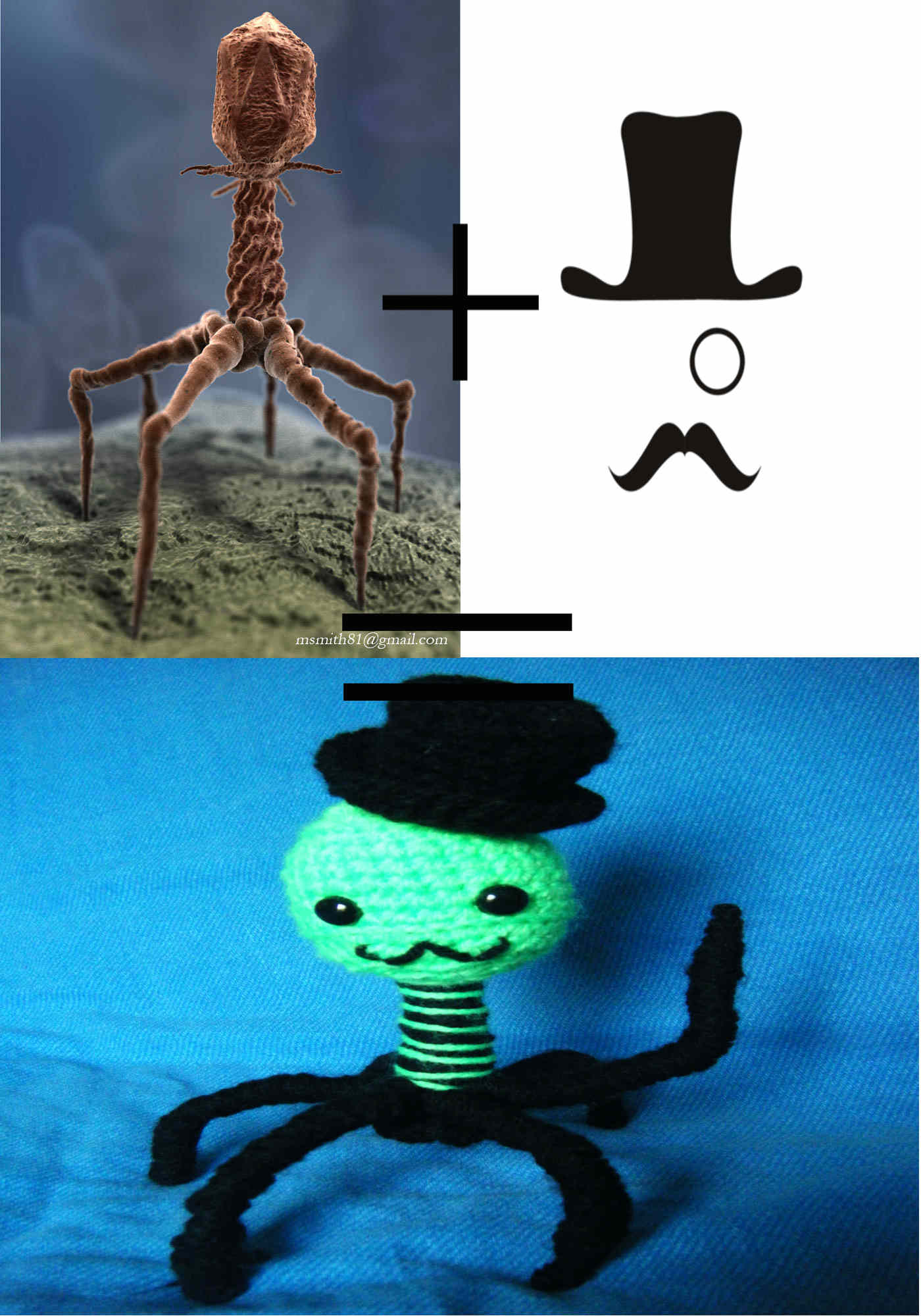
For what it’s worth, this is approximately what Mamissamus looks like when rendered into a physical manifestation:

            Don’t let the classy act fool you, Ma’am is one cunning strain, and not
                                        to mention totally into cross-dressing.

For the life of me, I still don’t know what the big draw was, but apparently Mamissamus (or, as you may have gathered already, Ma’am for short) had a particular penchant for mammalia DNA specifically. Without getting into too much detail, it wound its way right up there into the ancestral roots of warm-blooded, sexual vertebrates and latched on. Though mostly harmless, Mamissamus’s occupation within the mammalian lineage triggered a biological response that ultimately resulted in what is known today as “menstruation” — a rather messy business, from what I understand.

I should be honest with you, when I say “was” and “had” and otherwise treat this little anecdote as though it all took place a long, long time ago in the distant passed, the fact is that Lynic, the SI alluded to in the above, has been in a real tiff for the passed few days, which is about how much time has passed since he realized Ma’am was missing. How did a virus that only went AWOL a few days ago come to be responsible for eons worth of bleeding and serious discomfort, you ask? Well, being of Drendain origin, it has the ability to time travel. Obviously.

So anyways, it’s fallen to me to try to locate and retrieve the poor, lost virus. With any luck, Lynic and Ma’am will be re-united before long (and you warm-blooded folk will hopefully go back to not bleeding in strange places periodically). But please, whatever you do, don’t get your hopes up. Honestly, I really do have better things to do, and if I can’t track it down within the next day or two, I’m writing it off as being gone for good. If it comes down to that, you’re just gonna have to keep putting up with the after effects of Ma’am’s tampering until you figure out a way to adapt all on your own, mkay?

Have you tried, I don’t know, not letting yourselves be on biological autopilot? Really, going through the reproductive motions only when you actually want to reproduce is the way of the future. Just saying. Anyways, good luck with that!


Flora: Alluem Numana

Care and effort are hard to exhibit in the face of apathy and laziness. Such is the struggle I deal with when it comes to describing some of the finer details of Drendast. In this case, I have a very, very pretty picture in my head, but when I try to find the words to describe what it looks like, I lose interest. The struggle continues, such that I am determined to press on despite the lack of enthusiasm for doing so. Perhaps, that is a quality that sets me apart as a truly awful writer.

Perhaps, I am okay with that.

With that said, I have always loved trees. I know almost jack shit about them as they are in the present day natural world, but maybe that is for the best. I have more blissfully ignorant wiggle room to work with when when trying to describe the kinds of vegetation that exists in my mind’s world. In this case, I wanted to share some thoughts concerning a species of tree known as Alluem Numana.

The name “Alluem” just sounded cool to me, and “Numama” hints at a source of magic(k), and otherwise paints a more enchanted picture in one’s imagination. At least, that’s the hope.

I wish I had a great deal of plant taxonomical details to relay, but instead, all I’ve got are the gists: Alluem Numana are very much like oaks in that they are very large, green and broad-leafed, deciduous hard woods. Being as they are native to Drendast (and Drendast is nothing if not Earth enlarged in many respects), they typically reach the heights we see more commonly seen among Coastal Redwoods: that is to say, tall as fuck — and yet, like oaks on Earth, they’re far from being the biggest trees on Drendast.

Apart from their height, however, there’s also the fact that they glow at night to take into consideration. I could be wrong but, in my mind, the idea of trees that light up and give off an aethereal, enchanted aura of one sort or another after twilight has set in seems to be a fairly well established fantasy trope at this point in the history of fictional literature (and other media). I can’t trace where I first got the idea from, but I know it was before the release of Avatar. In either case, it can hardly be avoided in a place like Elyen, given that nightfall only takes place once every three years (or months, depending on your reckoning). Well, months or years all the same, the point is that there are long periods of darkness for one third of the time at any given point on the surface of Drendast on a consistent basis. Therefore, it should not be so strange that the ecology reflects that fact in unique ways (in this case, with vegetation that lights up when the suns finally take their leave).

Other than that, it should be mentioned that they belong to a family of temperate rain forest trees.

from http://en.wikipedia.org/wiki/Temperate_rainforest

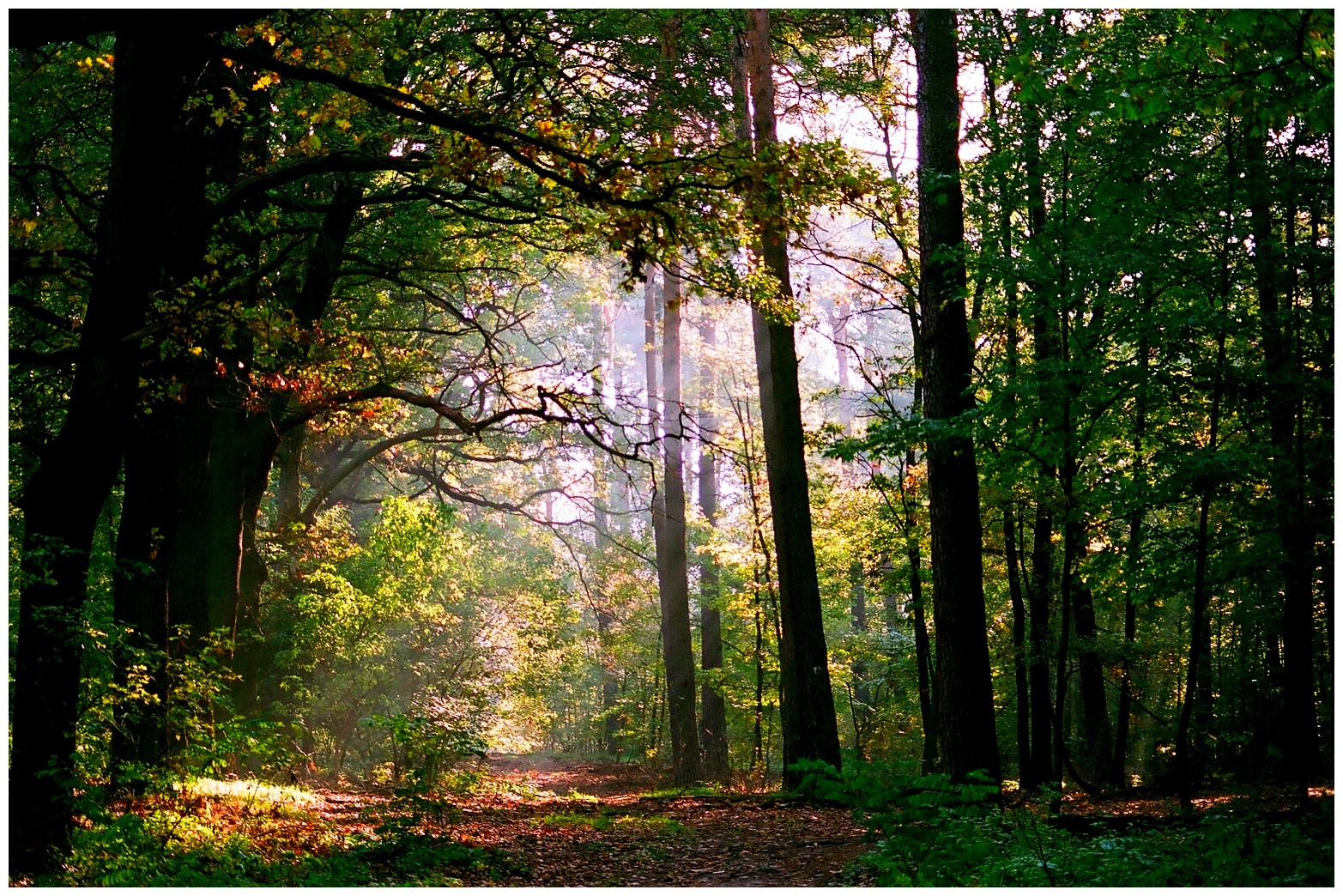
Like so, only with, you know… actual oaks… and glowy bits at night…

So, giant-ass oaks that glow at night. Ladies and gentlemen, I give you the Alluem Numana of Drendast. I will have a little more to divulge about them in a second entry I will link to from here in the future.

Drendast, Part 2: The Unknown

Image

What Earthporn ain’t good for, I’ll never know. Thanks to redditor Snahans for sharing this image here.

I can imagine a lot of similarities between Earth and Drendast. Forests, deserts, mountains, oceans, islands, and various other non-polar terrains. But when it comes to imagining (to say nothing of describing) what sets Drendast apart from Earth, I come up with as many misses as I do hits.

As mentioned in Drendast, Part 1: The Big PictureDrendast is a mega planet, nearly 100 times the diameter of the sun. It is so massive that it has three (3) suns orbiting around it, not the other way around. Prior to the fall of one of those suns, called Tropreus, into the planet, there was perpetual daylight. Life evolved in a manner which capitalized on that bountiful, endless supply of energy, easily able to meet all basic needs in peace. This meant no predation, no struggle to survive. Life was a free gift.

Additionally, the surface of the planet is more than 90% ocean, save for what looks like 12 little islands spread out evenly around its surface. Those islands, called Subworlds, are actually massive, Pangaea-sized super continents, connected to one another via a naturally occurring intra-planetary network of Conduits.

I could go on about other known features about Drendast, similar or different from what we might expect to find on Earth, but the point of this entry is to emphasize the fact that there’s still tonnes of details which are unknown or not clearly understood about the planetary super system. For example:

How is it that the gravity isn’t too crushing for complexity and, eventually, self-replicating proto-life forms to emerge? Does the presence of ether mitigate some of gravity’s more intense effects at that magnitude?

How are days marked with three suns in the sky, if at all?

Wouldn’t there be solar tides? How would they effect the planet’s surface?

In what ways is the climate on Drendast unlike that found on Earth?

Does Drendast have a determinable spin/rotation?

Does the Drendain stellar system orbit around anything else out in deeper space? Like how our solar system orbits around the super massive black hole in our galaxy’s center?

Are there other, more distant stars and celestial bodies? If so, are Drendains aware of this fact prior to the fall of Tropreus, given that it should be impossible to see stars in the night sky if there’s never any night?

Is there tectonic activity on Drendast prior to the Fall? If so, how does it manifest itself? Would it at least partly be caused by the orbits of the suns?

What is the present day role of the formative primordial ether at the planet and suns’ cores, if any? I mean, right now, it’s the ambiguous, cosmic, vaguely-spiritual, ultra caveat any sci-fi writer might like to have on hand to magically conjure up an otherwise impossible explanation for how and why things are the way they are, and I’m happy to use it to explain the cosmic origins of Drendast, but beyond that..?

If Drendast has no spin of it’s own, does it have a magnetic field? If so, how? Is it anything at all like that found on Earth? If not, again, how so? — I’m thinking the suns each contribute equally to what might be described as a dynamic, ‘Triune’ (or ‘three-in-one’) magnetic field around and resonating with Drendast.

Are there monsters on Drendast, despite ideal evolutionary conditions?

Drendast and the three suns may be deified by the Drendain peoples, but will they actually play a role as personified entities throughout the course of Drendain history, literally and directly intervening here and there, or no?

These and many more questions plague me somewhat, leaving what might otherwise be a fully immersive setting bereft with holes. Sure, there is supposed to be a given amount of perpetual uncertainty in the world of Drendast owing to the fact that it’s just so bloody huge that no amount of exploratory effort could ever observe everything there is to see under the suns even after thousands of lifetimes, but there are other mysteries, such as the ones listed above, which are only mysteries because I, as a writer, come up short for answers which I feel I rightfully should understand better.

So, I might as well just put it out there for any interested thinkers and dreamers to muse over. If you can imagine a sensible enough sounding state of things on Drendast which sufficiently answers one or more of these questions for me, and I go as far as to officially adopt it as cannon for what is known and true of Drendast, I will be more than glad to credit it back to you!

Any takers?

Drendast, Part 1: The Big Picture

Image

My best attempt to track down the original creator of this image came up inconclusive, but there’s a strong chance that credit for this picture goes out to BBC. Or Mother Nature. Or a space agency of one sort or another. Or an artist, you know, like the kind who render images like these for fun. Either way.

I’ve been sitting on a lot of ideas pertaining to the story I’ve been working on called Elyen for a long time now, but in all this time, I’ve hardly shared any of the details publicly. This is my first major disclosure of some of the bits and pieces I’ve got going on so far, starting first with the setting.

Much of Elyen toys with the idea of parallel universes/multiverses. In fact, Elyen is the name of a particular(ly large) multiverse, within which the characters will end up doing a great deal of sight-seeing. At the heart of Elyen is the planet Drendast, serving as a the primary hub between universes.

Drendast is a mega water-planet forged in the ether eons ago. It is absolutely massive. It originally sported no less than 12 super-continent sized landmasses called Subworlds spread evenly across its surface and separated by unfathomable distances of sheer ocean. It is so huge that rather than orbiting around a star, it had three of its very own sun-sized stars orbiting around it, ensuring a perpetual state of day light . 

Had, was the operative word. Around ten thousand years ago or so (according to the few surviving historical records), one of the suns orbiting around Drendast came crashing down, causing massive devastation in its wake. But rather than destroy the planet outright, Drendast happened to be SO huge that it absorbed the worst of the impact without crumbling apart or evaporating away. Many myths abound to this day attempting to explain the cause of the judgement that reigned down from the heavens that fateful day.

Originally, the three suns were Tropreus, Neora and Selah. Now, only Selah and Neora remain.

Originally, Drendast had 12 thriving Subworlds. Now, a full third of them have either been rendered uninhabitable, or were vaporized completely.

Much of the action in the early stages of the story will take place on one of the remaining Subworlds called Sarenalis (Ser`n`AY`liss). Before the Fall of Tropreus, there was never (or very, very seldom?) any night fall. Like on most Subworlds, many of the creatures which evolved there had the benefit of being photovorus (light-eating).

There was certainly enough sunlight to power all of creation indefinitely when all three stars circled the world. However, since the Fall, all life became a struggle. Sarenalis was one of the Subworlds least affected by the Fall since it was located on the complete opposite side of the planet from where the impact took place. Still, great suffering occurred there as much as anywhere else where the night touched.

Once great and peaceful creatures took to predation and killing all in order to survive in the face of scarcity and chaos. Civilization fell into disproportionate states of disarray. Many advances in medicine and technology were lost. Most importantly, the Subworlds, which were once connected to one another by a series of ethereal channels (often mistaken for wormholes by outsiders) called Conduits, were now completely isolated. The oceans between Subworlds were simply too vast to ever cross using most surviving conventional methods of transportation of the day.

Geographic separation began to take its course. At the height of Drendain evolution in the day was a humanoid race known as the Sævanii. Ever since the Fall, the separation between Subworlds forced the original Sævian line to branch out and become distinctly new entities.

Now, nearly ten thousand years following the calamity that Tropreus brought down, the Conduits have slowly begun to repair, re-establishing the links between the remaining Subworlds, but more than that, re-establishing the links between Drendast and the now-wild external multiverse at large. Mighty airships have also begun to make an appearance, slowly replacing reliance on the Conduits as the only way to get around the planet.

Many creatures have begun to adapt to the new nightfall conditions, even making sense of the star-and-constallation-filled night skies for the first time in all recorded Drendain history. New ecological niches have begun to mature. Balance and vitality were slowly being restored to the planet.

However, a new element began to materialize in the natural world still very much under-repair: Ambition. Can the devastated people of Drendast survive this strange new drive emerging from among them to carve out a competitive way of life for themselves so soon after their world was nearly destroyed?

Nothing To Do With Thermal Lensing

I have an idea, but it’s hard to explain. It’s about heat and life and stuff.

And, after a few days of being stagnant in the keeping-up-with-blogging department, I feel as though that is precisely what I should ramble about today: my difficulty explaining things.

The idea that I had been struggling with trying to share has lead to a deeper vice of mine, and that is that I struggle with describing things that are of a somewhat unfamiliar nature, period. If it were up to me to describe what snow looked and felt like to members of an uncontacted tribe in the Amazon in order to not be cooked alive (for whatever reason), I’d be screwed. Doesn’t matter how well acquainted am with the concept, it’s others whom I must enlighten.

So, when I want to write a book that’s intended to be chock full of interesting, weird, abstract concepts, and each of those concepts reinforce other strange ones, I am forced to go at it from a developmental approach: Start with the basics, establish a foundation, then build up.

The reason I find this difficult is because I want the reader to be plunged right in. I want to throw a reasonably diverse mixture of both familiar and unfamiliar ideas at them from the outset, so that way, there’d be things they can latch on to, and there’d be things they’re left wondering about.

From there, I fully intend on developing those unfamiliar threads in such a way that they gradually evolve in the reader’s mind, like a jigsaw puzzle slowly coming together, until they eventually become something they find intimately familiar. And/or, in the weaving of other concepts and threads, I will put a foundation together in such a way that all of the unfamiliar bits (which, to be fair, I would only mete out a reasonably little at a time) become instantly clear all at once, as though the reader were given the cipher for a crucial code they’ve been unable to solve for a long time.

So, my idea involving heat and life and stuff could be an unknown concept that instantly pops when the right information comes along, or one that slowly evolves over time, or, more likely, one that’s best left alone until the right fundamental principles that the universe of the story happens to abide by are first established. But therein lies another difficulty: it seems to me almost that all of the story’s universe’s fundamental principles are, themselves, unfamiliar and abstract.

So.

What does my story, Elyen, have in common with anything a human from Earth alive shortly after the turn of the 21st century might find familiar?

– The main characters are usually humanoid, so there’s often strong physical resemblance
– There are, more often than not, weather events that are similar to what we might expect here on earth
– Though the grander setting is nothing at all like Earth, from the perspective of a given humanoid character on the ground, the existence of mountains, bodies of water, forests, plains, desserts, etc., are all Earth-like enough for most readers to connect with
– Fantastic technologies exist which should be explainable in a way that fans of Sci-fi would have little difficulty appreciating
– Various forms of magic exist that fans of Fantasy will have little trouble understanding

I’m sure there’s more, but that’s just a cursory list for now. Here’s a list of some of the concepts I’m toying with which, I believe, are less common and therefore much trickier (but not impossible) to explain:

– “The Singularity” is the name of a type of major event that happens at various points throughout the history of the people of the story (yes, as in, there’s been more than one such event in Drendain history)
– Drendast is the name of the planet most of the events of the story takes place on. Drendast is a mega Aether-world, so large that it has multiple stars the size of Earth’s sun revolving around it, and not the other way around
– Most of the characters and beings on Drendast are photovores, naturally evolved [or, in some cases, genetically engineered] to subsist solely on the nearly perpetual light from the planet’s suns
– Physics on an Aether-world like Drendast are conveniently exotic. ‘Anomalies’, such as tri-pole magnetism, are taken for granted here
– The overarching philosophy behind the story incorporates, among other things, an offshoot of Taoism, which, if I understand anything at all about, only proves to me that I understand nothing at all
– Drendast happens to serve as a kind of ‘hub’ within it’s local multiverse, bridging connections via Conduits (think wormholes and you’ve basically got it) between universes both near and far.

And there’s loads and loads more concepts besides that.

The point is that I don’t always know where to start when it comes time to describe something. When I want to talk about a race of beings based on heat (rather than, say, carbon), I soon find myself struggling to explain their environment and behaviour, both of which involve (from the what I assume is a typical human perspective) altered states of reality, vaguely spiritual themes, Immersion (another very key concept I’m aiming to expound upon in the near future), and so on and so forth. Not easy.

Suddenly, explaining just one thing (what this race of heat-based beings are all about) is no longer just one thing, but many things, each of which are equally tricky.

I’m long winded. I’m still new to this whole blogging thing, and I don’t think I’ve quite figured out the most appropriate and tasteful format for presenting ideas, especially in terms of length, so, my biggest concern is not going on and on forever. To this end, I think I’m gonna start explaining concepts in parts. Starting after this blog, if I want to share a complex idea, expect to see it presented in chunks.

Or maybe I can do up a sort of wiki reference page, since I’m almost certain to reference earlier blog entries when presenting new ones related to Elyen. Something for me to look into. Anyways, that’d be all for now.